
Extra payload for e-trucks
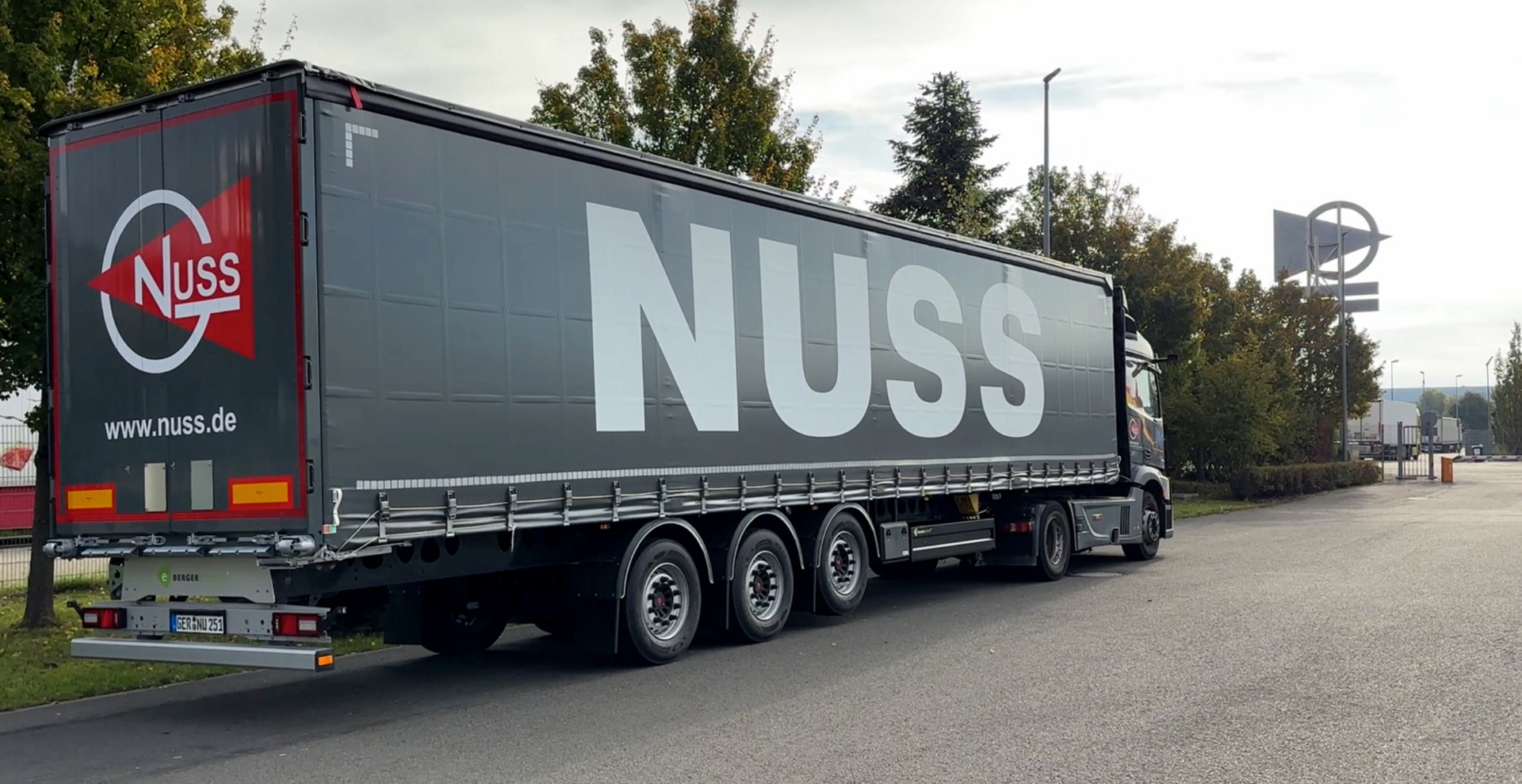
Decarbonisation of transport fleets is advancing at a considerable rate. Ever-increasing numbers of fleet operators are opting for battery-powered tractor units in order to transport goods with zero local emissions and no carbon emissions. And Spedition Nuss from Wörth am Rhein is one such operator. Over the next five years, Volker Nuss, the company’s managing partner, wants to switch two-thirds of his fleet to electric technology. “We always want to be at the forefront of the industry – particularly when it comes to sustainability,” he says. However, clean drive technology also has its drawbacks. Take the high unladen weight, for instance, which reduces the maximum payload – despite the permissible total weight being increased by two tonnes to 42 tonnes for zero-emission transport solutions. Depending on the configuration of the respective drive system and, above all, the capacity of the traction batteries, as many as three extra tonnes may be permitted.
„We always want to be at the forefront of the industry – particularly when it comes to sustainability“
Volker Nuss, Managing Partner at Spedition Nuss
And there is another small issue. While legislators have increased the permissible total vehicle combination weight, they have not increased the axle loads. So, the maximum load permitted on the drive axle remains at 11.5 tonnes. Even in conventional tractor units – which are three tonnes lighter than comparable e-models – this limit tends not to offer much of a buffer for transporters keen to exploit the full payload. When combined with a battery-powered tractor unit and two extra tonnes of total weight on top, the maximum permitted axle loads are quickly surpassed when the truck and trailer are fully loaded. “Lots of fleet operators have not even realised that distributing the axle loads can be a problem in articulated vehicles with battery-powered tractor units,” says Volker Nuss.
Technical tinkering prevents overloading on the truck’s drive axle
This problem can be resolved with a bit of technical tinkering. Schmitz Cargobull demonstrated this with a prototype at the 2024 IAA TRANSPORTATION. The Berger PerformanceEco 24LTOe’s wheelbase has been reduced to 5,740 millimetres (distance from the kingpin to the first axle). This is more than 500 millimetres shorter than standard. As a result, the centre of gravity moves towards the trailer’s rear and running gear, which offers plenty of spare axle load.
The trailers made by the Tirol-based lightweight design specialists are already especially well-suited for use with an electric tractor unit thanks to their low unladen weight, which is the lowest on the market. Even the basic version of the Berger PerformanceEco is one tonne lighter than comparable standard versions. When combined with the two additional tonnes added to the total permissible weight, it balances out the extra weight from the zero-emission drive.
Schmitz Cargobull’s involvement with Berger boosts trust
A clear choice for the sustainably- and economically-minded business owner Nuss: “I saw the Berger curtainsider at the transport logistic trade fair. The short wheelbase concept won me over straight away, and Schmitz Cargobull’s involvement with Berger boosted my trust in the vehicle’s technology even further,” he explains. He signed up to buy not one, but ten units. He will use them to transport heavy cargo, such as full beverage containers, paper rolls, old paper and automotive drive batteries within a 200-kilometre radius of his site in Wörth am Rhein. The plan is to use e-trucks as the tractor units, whose batteries have a capacity of 400 kWh and an empty weight of 9,570 kilograms. With a similarly extensive equipment package offered by Spedition Nuss, the Berger trailers weigh in at close to 5,400 kilos. All in all, this results in a payload of around 27 tonnes with a total permissible weight of 42 tonnes. “The high payload enables us to transport three extra CHEP pallets when transporting beverages, for example, which saves us one out of every 20 trips. The increased load is a very strong argument in favour of this technology for our customers,” he explains.
In addition to the weight improvements, the digital features play an important role for business owner Nuss. One of the other benefits to result from Schmitz Cargobull’s investment in Berger is that the lightweight “Made in Tirol” trailers are now equipped with a Cargobull Telematics unit as standard. Spedition Nuss will now be using this technology as well – particularly to maximise vehicle uptimes. “For our workshop, Schmitz Cargobull telematics technology offers the benefit that they can detect and resolve faulty tyre pressures and technical problems at an early stage – even before the vehicle stops working,” he explains.
Schmitz Cargobull bodies expand the scope of application
The Berger PerformanceEco has even more benefits to offer because all Berger trailers are now generally based on Schmitz Cargobull bodies. These include models such as the MEGA version with a hydraulic lifting roof or the aerodynamically enhanced EcoGeneration, a PowerCurtain version, and bodies with application-specific load securing certificates. “By introducing an interface between the Berger chassis and Schmitz Cargobull bodies, we have considerably expanded the scope of use and trailer benefits for customers, without having to sacrifice Berger’s lightweight DNA,” explains Matthias Muffert, Head of Product Management for General Cargo at Schmitz Cargobull.
„By introducing an interface between the Berger chassis and Schmitz Cargobull bodies, we have considerably expanded the scope of use and trailer benefits for customers, without having to sacrifice Berger’s lightweight DNA“
Matthias Muffert, Head of Product Management for General Cargo at Schmitz Cargobull
Volker Nuss also recently began using the PowerCurtain on his Schmitz Cargobull trailers, enabling interlocking loads to be secured without insertable laths. “If we’re pre-loading ten vehicles with paper rolls, this saves us around one hour of work. It’s an advantage that has real monetary value,” argues the business owner. For him, one thing is clear: Investing in Berger trailers is paying off and also making the use of electric tractor units even more attractive. As such, the vehicles represent another important driving factor in transforming fleets towards emission-free transport.
More information about Spedition Nuss
The Company
In 1934, Otto Nuss – the grandfather of the current Managing Partner – founded the company Spedition Nuss. He began transporting timber and bulk goods for the German state railway – though using a horse and cart back then. In 1955, his son Günter Nuss took over the company, with Volker Nuss joining as a shareholder in 1990. Today, he and Managing Director Alexander Ditz run the medium-sized transport and logistics company from Wörth am Rhein. Since then, the workforce has grown to 180 employees. Their site has 40,000 square metres of storage space, with an additional 15,000 square metres at sites in Kandel and Herxheim (in the state of Rhineland-Palatinate). And the company has its sights set on further growth. Last year, Volker Nuss purchased a 46,000 square-metre site belonging to automotive supplier Forvia in Hagenbach.
The company’s headquarters are in direct proximity to the Daimler Truck plant. Spedition Nuss provides services including Just-in-Sequence transport for the truck manufacturer. Other customers in the local area include one of Germany’s largest drinks manufacturers and a paper factory. Spedition Nuss sees itself as a full-service provider and also works on complex projects in the area of contract logistics. At its peak, Spedition Nuss had a fleet of 100 tractor units and 160 trailers. Volker Nuss has since reduced the number of in-house tractor units to 44 and trailers to 110 – this is down to the lack of skilled workers in the region. For this reason, the business owner has decided to stick to regional transport jobs. “It is easier to find professional drivers if they get to spend their evenings at home,” he explains. Permanent sub-contractors provide support for the in-house team.