
On the right track
As the Managing Director of Rubetrans Logistics, Florian Runden has a clear vision and specific objectives. “We want to rethink the approach to logistics and prove that the industry is more than capable of acting in a more forward-thinking and sustainable way. To achieve this, we need the One Power Strategy, with electric drives and consolidated transportation using eco-liners and source area cross-docking,” he says.
The logistics company, which is based in Steinfeld near Oldenburg in northern Germany, is aligning its approach with European climate objectives. Rubetrans Logistics is part of the family-owned Runden Group. This is made up of nine companies, all of which operate in different industries but share the common basic vision of the EU Green Deal.
“We want to rethink the approach to logistics and prove that the industry is more than capable of acting in a more forward-thinking and sustainable way.”
Florian Runden, Managing Director at Rubetrans Logistics
This mission statement is reflected in the practices in place at the Group’s logistics subsidiary, which has a large fleet of around 80 vehicles. For example, by using eco-liners and long trucks, Rubetrans Logistics can eliminate an entire vehicle from each route. In terms of drive technology, an increasing number of electric vehicles are being used alongside LNG trucks running on biomethane. From a long-term perspective, Rubetrans Logistics aims to switch its entire fleet to alternative drive systems with battery-powered electric vehicles being the clear favourite, preferably running on green energy from the company’s own photovoltaic infrastructure.
Electric drive systems for tractor units and trailers
“The transformation from diesel and LNG vehicles to electric drive systems not only applies to our tractor units, but our refrigerated semi-trailers as well,” explains Runden.
And so, it was perfectly fitting that Rubetrans Logistics began using the first all-electric refrigerated semi-trailer, the S.KOe COOL by Schmitz Cargobull, in mid-2023, just after the German Motor Transport Authority issued its overall vehicle type approval. The S.KOe COOL is characterised by its combination of generator axle, high-voltage battery and S.CUe electric cooling unit with built-in power electronics (more information available here).
“Sustainability means a great deal to a family-run company like us.”
Fabian Diekmann, Fleet Manager, Rubetrans Logistics
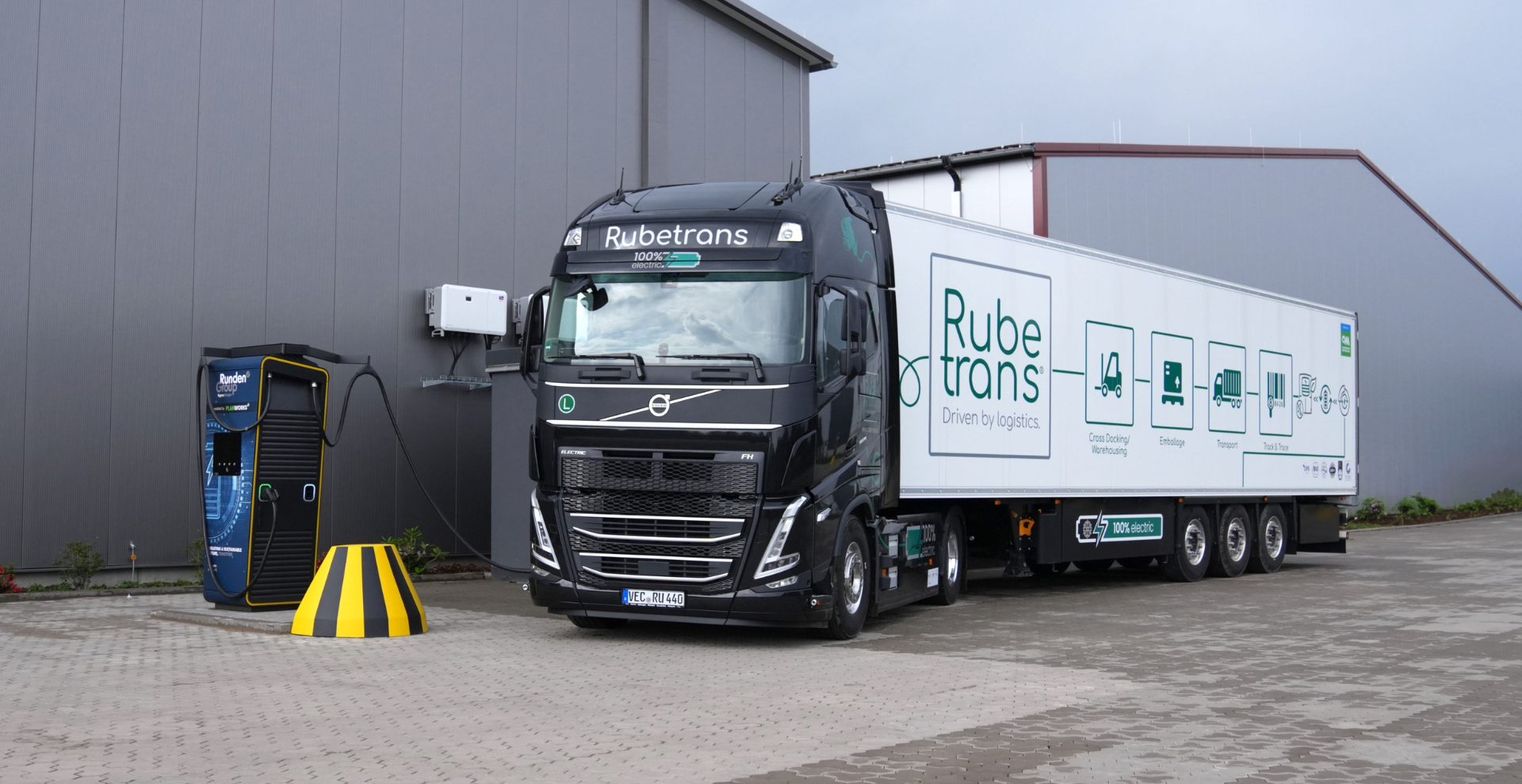
This first trailer – which is primarily used for hub-to-hub transport – was followed in the spring of 2024 by twelve additional S.KOe COOLs, one of which is used in a tractor-trailer combination with a battery-powered Volvo FH Electric. In June 2025, these are set to be joined by two more complete road trains, consisting of a Mercedes-Benz eActros and S.KOe COOL. These will be used for transportation between source area cross-docking and central warehouses for the German food retail industry.
Fabian Diekmann, Fleet Manager at Rubetrans Logistics, says: “Fuel and CO2 savings are the main reasons behind our decision to purchase these vehicles. Sustainability means a great deal to a family-run company like us and it is also important in many other areas of our company. We are thrilled to be able to keep advancing the electrification of freight transport and, as such, become a pioneer for the entire transport industry.”
A concept that also considers the driver
The company’s drivers are also excited about the extremely quiet, zero-emission refrigerated vehicles. “A lot of the feedback we are getting highlights the overall reduction in vehicle noise and the noticeable drop in vibrations. While charging times and ranges may require greater consideration and organisation, the consensus seems clear: None of our drivers in electric vehicles want to switch back to combustion engines,” says Runden.
Drivers at Rubetrans Logistics are valued highly, whether it comes to vehicle selection and equipment, regular training courses, or basic demand for local or long-distance transport jobs. As such, employee fluctuation is low: many of the company’s professional drivers have been there since its infancy, and long service awards are handed out on a regular basis.
.
Speaking of the company’s early days: a steady increase in the transport of fresh eggs to and from the Waden & Runden OHG plant was one of the main reasons why Senior Director Bernhard Runden decided to set up Rubetrans Transport as an additional, stand-alone transport company within the group back in 1992. In 2020, the company transitioned from one generation to the next, with Bernhard Runden passing the reins to Lisa and Florian Runden. This also coincided with the creation of the Runden Group as the overarching holding company, followed by renaming of the logistic subsidiary as Rubetrans Logistics.
The growth of a partnership over many decades
„“We have been Schmitz Cargobull customers for many years. “If you include the earlier factory transport operations, then it must be around 50 years. It has always been a great working relationship, based on trust and fairness,” says Runden.
As a result of this long-standing partnership, Rubetrans Logistics not only uses Schmitz Cargobull bodies, trailers, semi-trailers and telematics solutions, it has also become a genuine specialist in another area: its in-house workshop has a DEKRA-certified test centre and not only looks after all tractor units and trucks – from traditional diesel systems to electric trucks – but, as a Schmitz Cargobull agency workshop, also deals with refrigeration technology – including the brand new S.KOe COOL.
The cross-docking strategy at Rubetrans
Refined logistics as the recipe for success
Certified warehouse logistics plays an important role at Rubetrans Logistics – with fewer process steps and shorter transport routes as key factors thanks to source area cross-docking. In addition to handling and consolidating pre-picked goods, suppliers are also able to store inventory on a temporary basis and then use this inventory to compile orders for food retailers at individual packaging unit level. With this multi-stage system, Rubetrans Logistics not only minimises storage space requirements and warehouse costs, but also guarantees lower throughput times and the timely delivery of goods with a maximum level of freshness.
“We are first and foremost a service provider for source area cross-docking for the categories of Fresh and Ultra-fresh in the German food retail industry.”
Florian Runden, Managing Director at Rubetrans Logistics
One of the positive side effects of this transport consolidation is that it saves on CO2 emissions. As well moving goods in and out of warehouses, Rubetrans Logistics also offers additional services, from inventory accounting and quality control in accordance with customer specifications, through to returns management. Track & Trace and temperature tracing are also part and parcel of the services available.
Thanks to its own dry and fresh goods warehouses and its specialist vehicle fleet, Rubetrans Logistics serves the German market all-year round and also offers long-distance services, primarily covering Austria, Belgium, Denmark and the Czech Republic, but also the Netherlands and Switzerland.
Addressing the biggest challenges at present, Runden highlights spiralling costs: increasing labour costs, high energy costs and road tolls, plus rising prices for trucks, trailers and semi-trailers. However, he believes that electrically powered and networked logistics facilities for refrigerated logistics are a remedy to this, and one of the biggest topics for the future of this sector. And the second big issue according to the logistic expert?
“The continued consolidation, digitalisation and decarbonisation of goods flows,” he says. But when it comes to source area cross-docking, Track & Trace and electrification – three key factors in this transformation – Rubetrans Logistics is already on course.