

VECTO for trailers
With the introduction of EU Regulation 2024/1610, trailers are now subject to CO₂ reduction targets, even though, as non-powered vehicles, they do not produce emissions. To assess these requirements, the EU uses the simulation tool VECTO (Vehicle Energy Consumption Calculation Tool), a model that classifies trailer configurations according to theoretical efficiency assumptions. The calculation logic is not based on the actual requirements of freight transport, but on a simplified, idealised model of the transport process.
Simulation vs practice: Where VECTO overlooks real-world efficiency
In the simulation, certain technical features are classified as inefficient, even though they often have the opposite effect in real-world use. This is particularly evident with equipment such as tail lifts, on-board forklifts and intermodal equipment. In practice, it is precisely these items that help to make goods flows flexible, while reducing downtime and avoiding empty running. VECTO, however, assesses them as detrimental to the carbon footprint, and thus creates an administrative logic that hinders efficiency rather than promoting it. Other real-world efficiency benefits are not given enough credit using the tool. Lightweight construction, for example, enables higher payloads, and it is particularly advantageous for bulk transport or heavy goods, helping to reduce the number of journeys required. However, using VECTO, this is viewed solely as weight optimisation, and its payload advantage is completely disregarded.
Misleading incentives with real-world consequences for traffic and the environment
The discrepancy between simulation and reality can have serious consequences. When companies are required to adhere to guidelines that are advantageous from a modelling perspective but inefficient from an operational standpoint, it leads to poor decisions. Namely, more journeys, higher traffic volumes and, consequently, an additional burden on the environment. Modern trailers already demonstrate that technically sound measures, such as aerodynamics, reduced rolling resistance and lightweight construction, can unlock real potential for savings. However, these demonstrable advances are scarcely given adequate consideration with VECTO.
Heavy fines despite targets that are very challenging to meet
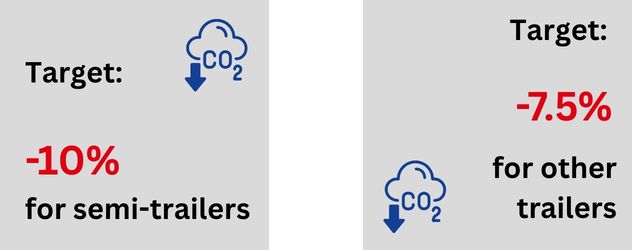
Particularly problematic are the mandated reduction targets of 10% for semi-trailers and 7.5% for other trailer types, which, from 2030 onwards, will be subject to fines of €4,250 per gram of CO₂ per tonne-kilometre for each registered vehicle. The threat of such penalties is putting many manufacturers under considerable pressure, not because they reject climate protection, but because the targets are scarcely achievable and threaten their survival. The economic risks are considerable, as investment could be channelled into measures that look good on paper but make no contribution to more efficient transport. Andreas Schmitz describes the situation as “a massive misallocation of capital”, with potentially significant consequences for the environment, economy and employment.
Competitiveness and jobs at risk
The penalties not only jeopardise the environmental impact of the regulation, but also the competitiveness of European companies. If other regions of the world can rely on solutions that meet genuine transport needs, whilst European manufacturers are restricted to meet model-specific requirements, this creates a significant competitive disadvantage. As a result, according to industry analysis, more than 70,000 jobs are at stake. The German Association of the Automotive Industry also warns that the CO₂ targets for the fleet are technically unachievable and that the regulation, in its current form, poses an existential threat to many European manufacturers.
Three key demands from the industry
To avoid economic damage and undesirable environmental consequences, the industry is calling for three key changes:
1. The abolition of VECTO as a basis for assessment for trailers
2. A moratorium on fines for as long as the targets are technically unachievable
3. The inclusion of zero-emission tractors in the CO₂ targets for trailers (ZE Vehicle Correction Factor).
30 European trailer manufacturers came together in Lier and signed a petition calling for a review of the CO₂ Regulation (EU) 2024/1610.
Climate protection requires practical solutions
Schmitz Cargobull supports the EU’s climate targets and sees them as a key driver for progress in the transport sector. However, this requires regulations that align with reality. CO₂ targets can only be effective if they are practical, economically viable and technically feasible.
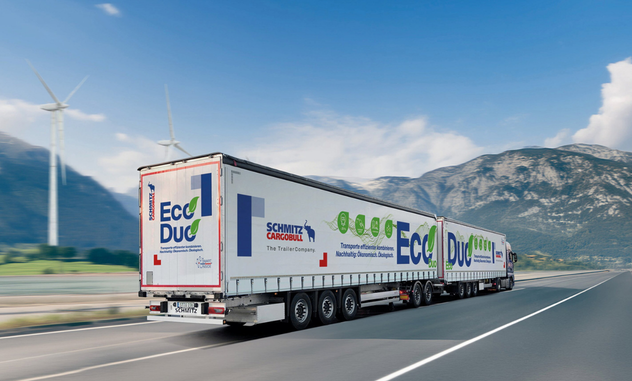
With solutions such as the EcoDuo long-haul truck concept – a pilot project successfully completed in Germany and already in use in Spain, Portugal and Scandinavia – Schmitz Cargobull has shown an efficient concept that enables CO₂ savings through greater capacity without compromising the functionality of supply chains.
FAQs about VECTO
-
What is VECTO and how did it come about?
VECTO is a simulation tool developed by the European Commission that calculates the energy consumption, fuel consumption and CO₂ emissions of heavy-duty vehicles. It was developed over several years because the EU needed a uniform, comparable method to measure the consumption of new lorries and subsequently monitor CO₂ limits. To this end, VECTO uses technical parameters such as aerodynamic drag, rolling resistance, vehicle weight and engine power to simulate a vehicle’s behaviour on standardised driving profiles. -
What do the plaintiffs hope to achieve in court?
We expect the ECJ to give due consideration to the substance of our arguments and to take account of the reality of transporting goods. Our aim is to have the regulation declared null and void in its current form, as it is technically unworkable and poses a threat to the survival of businesses.
-
What is the status of the lawsuit or the appeal lodged?
The General Court of the European Union dismissed the action against certain provisions of Regulation (EU) 2024/1610 as inadmissible. The decision was based on procedural grounds and did not address the substantive arguments put forward by the applicants. According to the Court, the eight applicants were not considered to be “individually concerned” by the contested provisions. The subsequent appeal was deemed admissible by the Court of Justice of the European Union (CJEU); however, it was dismissed on 1 October 2026. In doing so, the CJEU upheld the finding that the applicants lacked individual concern. As a result, the substantive criticisms of the Regulation have still not been examined by the courts. This makes political dialogue all the more important. The outstanding substantive issues should now be addressed and discussed as part of the planned review of the Regulation. -
Why does Schmitz talk about a “misallocation of capital”?
Because the system channels resources into optimisations that only work in theory but are of no use in real-world operations.
-
Why does VECTO place an additional burden on the environment?
VECTO favours vehicles that are less suitable for certain transport tasks. Essential equipment such as tail lifts, on-board forklifts or intermodal capability (ferry/rail) receive a negative rating, even though in practice these reduce empty runs and increase efficiency. The result is theoretical CO₂ savings, but an additional burden on the roads. -
Manufacturers are calling for CO₂ taxation, or the price of diesel, to be used as a lever. How should this be structured?
CO₂ pricing is a market-based polluter-pays instrument for controlling emissions. It should be transparent and fair; blanket government subsidies are not suitable for this purpose. Rising CO₂ costs are increasing the pressure to switch to electric lorries. The growing proportion of electric lorries must therefore also be taken into account in the VECTO reference tractor unit, which has so far been defined entirely on a diesel basis.
-
Which technical measures are effective – and where are they counterproductive?
The key measures for reducing fuel consumption are electrification, lightweight construction, improved aerodynamics and low-rolling-resistance tyres. Their effectiveness depends heavily on the specific application.
The theoretical model underpinning VECTO cannot fully capture the complex requirements and conflicting objectives of real-world transport. Technical optimisations that yield benefits in the model lead to disadvantages in use, for example through loss of payload, reduced load volume and higher costs. An analysis that takes actual operating conditions into account is therefore required.
-
If the regulation remains as it is, what fines can Schmitz Cargobull expect from 2030 onwards?
As part of the penalty scheme for failing to meet the targets, a fine of €4,250 per gram of CO₂ per tonne-kilometre is stipulated.If the reduction target is missed by 2.5 percentage points (7.5% instead of 10%) and production stands at 57,000 vehicles (75% of which are VECTO-relevant), the annual levy would amount to around €163 million. Under these circumstances, production in Europe would not be economically viable.
-
What does a ‘perfect’ VECTO trailer look like – and what are its drawbacks?
A “perfect” VECTO trailer would be extremely light, only 3 metres high, aerodynamically optimised and devoid of any additional equipment such as spare wheels, toolboxes or pallet boxes. In practice, that would mean less payload, more trips for the same transport task, limited application possibilities, and higher costs for customers. Actual transport efficiency would decrease.